How to Count Cards in Blackjack Expert Guide & Promo Tips
Card counting in Blackjack is often mythologized by Hollywood movies as a supernatural ability reserved for mathematical prodigies. In reality, card counting is a structured, legal technique of tracking the ratio of high-value to low-value cards remaining in the dealer’s shoe. When executed correctly alongside strategic promotional play, it turns the statistical house edge in favor of the player.
This comprehensive guide breaks down how to count cards in blackjack, explores the classic Hi-Lo system with mathematical evidence, and details how modern players leverage news updates on promotional codes to maximize their overall expected value ($EV$).
1. The Core Mechanics: How Card Counting Works
At its foundation, card counting relies on a simple probability shift. High cards—specifically 10s, Jacks, Queens, Kings, and Aces—benefit the player, while low cards (2s through 6s) benefit the dealer.
-
Why high cards favor the player: High-density shoes yield more natural Blackjacks (which pay out 3:2), increase the dealer’s probability of busting when hitting stiff hands (12 through 16), and make double-downs significantly more lucrative.
-
Why low cards favor the dealer: Low cards prevent the dealer from busting on weak hands while diluting the player’s chances of hitting a 20 or 21.
By tracking these ratios, advantage players know exactly when to increase their bets and when to pull back.
2. Step-by-Step Guide: The Hi-Lo System
Developed by Harvey Dubner in 1963 and later refined by Stanford Wong and Edward O. Thorp, the Hi-Lo System remains the industry-standard card counting method due to its high efficiency and relative simplicity.
Step 1: Assign Point Values to Every Card
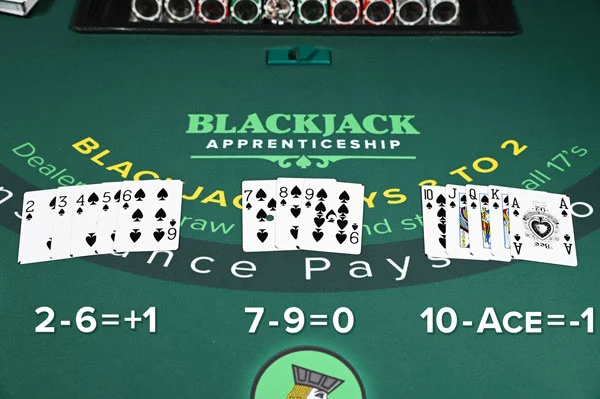
You do not memorize specific cards; instead, you track a running tally by assigning three basic point values:
| Card Values | Point Assignment | Category |
| 2, 3, 4, 5, 6 | +1 | Low Cards (Good when removed) |
| 7, 8, 9 | 0 | Neutral Cards |
| 10, J, Q, K, A | -1 | High Cards (Bad when removed) |
Step 2: Maintain the Running Count
As the dealer deals cards from the shoe, calculate the sum in real-time.
Example Execution:
The table receives:
King (-1),5 (+1),3 (+1),Ace (-1),8 (0),2 (+1).Calculation: $-1 + 1 + 1 – 1 + 0 + 1 = +1$.
Your Running Count is $+1$.
Step 3: Convert to the “True Count” (Multi-Deck Adjustment)
Most physical and online live-dealer casinos use multi-deck shoes (usually 6 or 8 decks). A Running Count of $+4$ with 5 decks remaining is far less potent than a $+4$ with only 1 deck remaining.
To calculate the True Count, use the following formula:
-
Scenario: Your Running Count is $+6$, and you estimate there are $3$ decks left in the discard tray.
$$\text{True Count} = \frac{+6}{3} = +2$$
When the True Count reaches $+2$ or higher, the statistical edge shifts from the house to the player.
4. Betting Correlation and Spread Strategy
To monetize card counting, you must scale your wagers in proportion to the True Count. This adjustment is known as a Bet Spread.
-
True Count $\le +1$: Bet minimum (e.g., $10).
-
True Count $= +2$: Bet 2 units ($20).
-
True Count $= +3$: Bet 4 units ($40).
-
True Count $\ge +4$: Bet 8 units ($80).
Mathematically, a standard 1-to-8 bet spread combined with perfect basic strategy yields an expected player advantage of approximately 0.5% to 1.5%.
5. Integrating Card Counting Concepts with Casino Promotions & Reward Codes
While traditional card counting operates at physical tables, modern players often combine strategy with online promotions, welcome rewards, and promotional codes published on dedicated news platforms.
Leveraging Bonus Codes for Maximum Edge
Promotional codes and deposit match bonuses provide an artificial boost to your starting bankroll. When paired with basic strategy and pseudo-counting in live-dealer games, bonuses effectively offset variance and lower the required bankroll.
-
Wagering Requirement Calculation:
Always verify the playthrough requirement for blackjack. If a platform offers a 100% match up to $500 with a 10x rollover on table games, your total required play is $5,000. Applying a mathematically sound strategy minimizes the expected loss during the rollover phase.
-
Claiming Reward Codes Safely:
Stay updated via reliable news portals that publish verified promo codes, cashback incentives, and seasonal chips. Utilizing a 10% weekly cashback code, for instance, adds an extra layer of insurance against negative variance during cold decks.
6. Common Pitfalls to Avoid
-
Ignoring Basic Strategy: Card counting is useless if you do not strictly follow fundamental basic strategy tables. Master basic strategy before attempting to count.
-
Over-betting Bankroll: Even with a $+4$ True Count, the house still wins individual hands. Maintain a minimum bankroll of at least 100 max bets to withstand natural statistical swings.
-
Underestimating Live Dealer Shoe Penetration: In online live-dealer games, shoes are often shuffled at 50% penetration (3 decks out of 6). Low shoe penetration significantly limits card counting efficiency.
💡 Summary for Advantage Players
Mastering how to count cards in blackjack requires disciplined practice: memorize card values, practice keeping a running count with a physical deck under 45 seconds, and convert to the True Count effortlessly. Simultaneously, track industry news for active promotional codes and deposit bonuses to maximize your win-rate and preserve your bankroll efficiency.